What will it take
the prospect — it nags, it drags

1.
I’ve been thinking about estrangement again. I’ve been thinking of ending things with my mother and my father and I wonder if every time I visit my therapist, she thinks, ‘Well, there’s an obvious solution to your problems’.
I spend my birthday money to see her. Monthly, usually, but when my parents are in town it turns into weekly, and I cringe when I see the deduction notification from my bank. No Medicare rebate, by this stage.
It’s been at least four or five years since she first suggested it. I open Issendai’s ‘Missing Missing Reasons’ every few months, and re-read its analysis of estranged parents’ forums and the kinds of common narratives erected against their child to maintain the parents’ victimhood against the perceived persecution by estrangement.1 Each parent is desperate for connection with their estranged child, but remain ‘willfully deaf’. Everything must be on their terms, including reality; ‘context is malleable because the full picture may not support the [parent’s] emotion.’ The blog offers an opportunity to try on the possibility; I can hear each forum post included in the analysis in my mother’s voice. I feel myself tense around the shoulders, and resist.
In the next session, I vent about the most recent weekend phone call. My therapist contorts her face reacting to my mother’s latest antics, and I believe her, but I can’t help but wonder if she’s looking at me with a degree of exasperation — hey, remember that thing I suggested?
2.
When they come to Melbourne, the city becomes suffocating. Every street carries risk. If I run into them they’ll demand explanation; better not to go anywhere. At home I live in a fog, drifting from room to room. A friend asks at a gathering, ‘What’s something you say so much it would become your action figure catch phrase?’ and the first thought that pops in my head is, ‘I want to kill myself’. K--- must be tired of hearing my passive suicidality. We try to make plans, but for me everything is paused until the 27th, when they board the early morning flight back to a distance where phone calls are more manageable than hours of time in person, spent trying not to offend as they stand much too close, talking at me. A breath held; a shoe, hanging.
At brunch with them my stomach shrinks to a walnut shell. I manage half a slice of sourdough and a bit of egg, and then I need to run to the bathroom — a brief reprieve, but then I can hear my mother’s shrill worrying through the door. I put on a neutral face before leaving the stall and return to the table, patting wet hands on my jeans nervously; I feel like I’m hovering. Maybe she’s annoyed I didn’t respond. I worry the brunch will turn into the dinner where Mom and I exploded at each other over Thai food; I worry the brunch will turn into the other dinner where Mom belittled my clothes; I worry the brunch will turn into the other lunch where I had to run away to the bathroom to throw up. I wish I’d taken a Valium before coming out.
3.
I lose all sense of self. I forget everything outside this horrible family. I am grieving a different version of myself every day. Someone on Reddit asks what it’s like to ‘heal’ and I put on a voice to answer. Actually, I am always putting on a voice. Different voices for different occasions. In class I am warm and attentive (so I’ve written on my CV). At K---‘s family home I am mousey and small because I don’t know how to be around family and not fear retaliation. Around Mom and Dad I am loud and agitating — I can hear the irritation and I can’t stop it. Mom knows how to push my buttons, and I know how to play my role: I am always offending someone. Usually it is Mom, but sometimes Dad has to step in and be offended on her behalf, because she would prefer, for her ego, to pretend not to be offended and only concerned in the way that only a parent could be. Then Dad takes it too far and puts his hands on me, and then Mom has to step in. That was years ago, anyway. Dad doesn’t get physical anymore. Instead, he sits there with a stupid smile on his face, trying his best to appease Mom. He forgets I am also his child.
4.
I don’t know what it could have been like to be a happy child. I was always in trouble for something, and when I cried Mom would point at me and say, ‘What have you got to cry about?’, and I would think about how we lived in a big villa and I had my own bedroom, and even my very own matching set of orange furniture (though of all the colours I would have preferred blue, or maybe green), and how we went on vacation every Christmas. I always did the wrong thing, somehow, though I don’t know if I believe that anymore. I believed that I was ‘bad’, and if only I were ‘good’ my mother’s life would be easier, and to become ‘good’ I just needed to do everything different. But there was one time when I was in middle school and started going on Tumblr that I printed out a graphic with big bold letters. I don’t remember what it said exactly, but it was a joke about how parents get mad at everything and I thought it was funny, and that maybe Mom and Dad would think it funny too, but when I stuck it above the light switch with some masking tape my hands shook a little. It took Mom a second to read it, and when she finally comprehended it, she got that tone in her voice that summons Dad, and then they were both in the doorway to the orange bedroom, yelling at me, and I had to take the funny joke graphic down. The doubt began then: how could something so playful turn catastrophic? Why were they unable to see it as the innocent joke that it was? A flash of confusion, but quickly I was back to thinking maybe I should have been more considerate towards Mom, because it must not be nice to be mocked by your 10-year-old child.
Now, I think it is a bit ridiculous to be thirty years old and feel butthurt by a stupid internet meme your child printed out; it took me a decade to get here. But Mom weasels her way into me anyway, and I am looking for her offence everywhere. Anticipation becomes my best skill, even though I have no power over what comes next. My memory takes on a colour, and I lose connection to a core of myself, replaced by what Scottish psychiatrist R.D. Laing calls the ‘persecuting observer’, which ‘kills and withers anything that is under its scrutiny’.
5.
In 2005 we went to Florida, our first time in the US. In the photos I look like an annoying child, a whiny one that doesn’t sit still, won’t listen. My skin is too tan, and my flyaways are everywhere. Mom has tied half of my hair up, and I have a halo of baby hairs I tried to press down. I feel embarrassed taking the photo between two giant nutcracker statues. I look self-conscious. Oh, this is when it started.
6.
They took a lot of photos that year. Some in the garden with my older sibling, arm in arm, dressed in that striped set Mom liked so much that I kind of didn’t (because it didn’t have sleeves and came with a skirt), but kind of did (because Mom loved dressing me up in it). There are a lot of photos of me looking uncomfortable next to Dad. I can feel it — just got yelled at, but inconveniently because we must document Disneyworld. So get in, feel the painful grip of Dad’s hand on your skinny arm, hold your breath for the second the camera shoots. Try to smile.
My therapist asks me to look at these photos of little me and surface any feelings. The primary feeling I notice is disgust. I wonder if how I feel is how my mom felt. In one of the photos my sibling, my mom, and I are sitting on a curb. I am laughing, my eyes closed, leaned towards Mom. I see an inaccessible emotion; this scene is no longer a possibility.
The photos from my tenth birthday hit the hardest. I look happy, but any positive memory seems to have been overridden by revulsion in reaction to the happy anticipation for the cake. Across the table, Mom jokes that I was an alien baby. She says this between bites of the cake, chocolate decorated with a hard candy cow. She says I was a baby they rescued from the garbage, which is why I am so different and disobedient. I have always tormented her — I didn’t feed properly and still don’t. I am made to sit at the dinner table, picking at the last grains of my rice, forbidden from leaving until the bowl is empty. Before long I develop a stomach problem — it doesn’t want to keep eating, so it protests, in a way that I cannot. I learn almost a decade later that you can have migraines of the abdomen, which is a common symptom of trauma. Everyone has IBS and so do I, and it becomes another burden at family dinners, another secret I must protect from Mom’s offence.
6.
After brunch we go to the market. When we finish our rounds, Mom asks what we’ll do next; K--- and I want to go home. I’m tense because things have been going well but I know the question comes with an expected answer, one that I don’t want to comply with. Mom is immediately upset; she turns away with a jerk. We find a bench to sit on, and they try again to negotiate with me when they’ll see me next, and I think to myself that theoretically I should be grateful to have a family that want to see me. But I’m scared and I need a break from the damage they are doing to my body, and of course I cannot say that. So I mumble something about work, while K--- sits next to me, unable to follow the conversation that is slowly turning bitter in Chinese. Mom refuses our offer to walk them home even though I thought she’d be happy to spend more time together, but she is just offended again, victimised by my inability to meet her every desire. She will blame me for this later.
7.
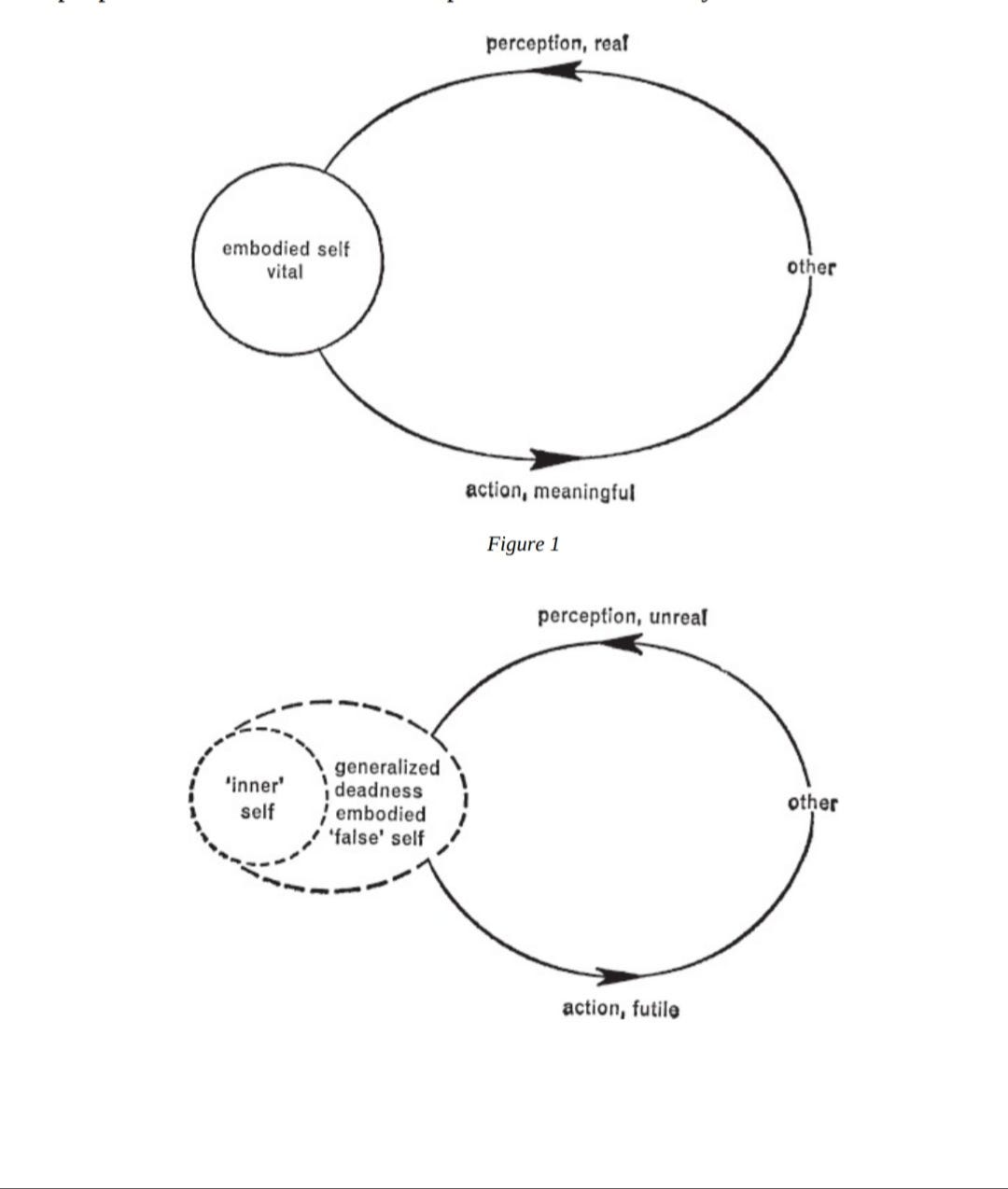
In his book The Divided Self, R.D. Laing theorises that psychosis and schizoid personalities come from a splitting. When external forces threaten one’s sense of ontological security, one builds a ‘false self’, presented externally, to distract from and protect the ‘true self’. ‘What the individual regards as his true self is experienced as more or less disembodied, and the bodily experience and actions are in turn felt to be part of the false-self system,’ he writes.2
I turn my true self away, in the hopes that I can stop taking psychic damage from everything coming out of Mom’s mouth. She complains that I never tell them anything about my life, that I should make more time to see them since they’ve come all this way, and, sometimes, she’ll say that she should never have had children if she knew they’d turn out like me. It confounds me that she can’t seem to see what’s happening between us. I’m arguing back in my head and filing these ugly things away as proof of my hardship. I stay quiet until she runs out of steam. K--- and I go home.
8.
How long will this last? In therapy I am running in circles. I feel stuck. My frustration pours out again, and every time it does, I seem to gain nothing but a cleverer way of wording it. This week I say to my therapist, ‘All they communicate with me is disappointment and demand’; she writes it down on her iPad, and we come back to this idea later. We discuss how the primary mode they operate in is persuasion and command; the primary mode they expect me in is compliance and appeasement. But even compliance and appeasement are impossible from me — everything I do or don’t do, say or don’t say, becomes a weapon.
9.
I spend an evening memorising the poem ‘Wild Geese’. Written by American poet Mary Oliver, who described her own childhood as ‘dysfunctional’ and was the victim of child sexual abuse, the poem invites the reader to release the desire to be ‘good’; to instead ‘let the soft animal of your body love what it loves’.3
I don’t think I know what it is to be good. I have learnt — tried to learn, tried to embody — that I do not have to be good; besides I seem to have never been. I seem to have been walking on my knees through the desert repenting my whole life, or at least since I fell out of my mother’s favour. I don’t remember which comes first because it all seems the same to me, because where my memory begins, I have always been doing the wrong thing. I have been hiding that soft animal of my body inside a deep well. The wild geese cannot see me — the mountains and rivers cannot feel me — the trees cannot hear me. I wish to feel the sun on my face and the stream run over my feet. I am wild with envy.
10.
I come the closest I have ever come to crying in a session, when my therapist affirms that I am indeed in an impossible situation. ‘Impossible’ becomes the word that follows me for the next week. The unspoken words are loud in my head: impossible, but only under the circumstances in which you continue a relationship with them. I am projecting, most likely, and however impossible the current situation is, estrangement feels even more impossible — after all, I have spent 28 years of my life loving my parents, whatever that means, and paying the cost, and it is familiar in my body. I pull myself back from the feeling welling up inside me, a biological rebellion against the prospect of having no parents. It is probably the most agentic thing I could do, leaving, because all I have known in being someone’s child is being denied agency. A stone in my throat, a clenched fist in my abdomen; the feeling is forward in my face, a spillage waiting to happen. My body doesn’t know where to go — it is rebelling in every which way, against the tension of the relationship but also against the foreignness of estrangement. On the walk home, I keep thinking: what will it take?
Thank you to R and C for editing drafts of this piece.
I’ve found the Karpman drama triangle an instructive concept here, a model illustrating destructive dynamics that can arise during conflict. The three possible roles that people can take on are victim, persecutor, and rescuer, and each role is not a direct translation to the true dynamics at play (for example, someone who takes on the victim role may not be the actual victim). Taking on these roles and maintaining the triangle does not move the people involved towards resolving the problem, but rather helps fulfill their unconscious goals or agendas, leaving the actors feeling justified and entrenched in the respective positions they feel most comfortable in.
In the case of estranged parents and their adult children, the parents might ‘play’ the victim (or one parent does, and the other parent plays rescuer) and cast their child as the persecutor.
This detachment means ‘that the self is never revealed directly in the individual’s expressions and actions… The self’s relationship to the other is always at one remove.’
Wild Geese
You do not have to be good.
You do not have to walk on your knees
For a hundred miles through the desert, repenting.
You only have to let the soft animal of your body
love what it loves.
Tell me about despair, yours, and I will tell you mine.
Meanwhile the world goes on.
Meanwhile the sun and the clear pebbles of the rain
are moving across the landscapes,
over the prairies and the deep trees,
the mountains and the rivers.
Meanwhile the wild geese, high in the clean blue air,
are heading home again.
Whoever you are, no matter how lonely,
the world offers itself to your imagination,
calls to you like the wild geese, harsh and exciting --
over and over announcing your place
in the family of things.