The technology doesn't really matter
Letting go of an aesthetic-driven technology future

“I’m sorry, but this fucking sucks.”
A tweet from Paris Marx, tech critic and newly (nearly?) published author of Road to Nowhere: What Silicon Valley Gets Wrong about the Future of Transportation, referring to Apple’s newly announced CarPlay, touted as the “smarter, safer way to use your iPhone while you drive”. We can have apps on a dashboard, pixels on a screen behind the wheel — we live in the future!
But, Marx, why not integrate your phone into your car? Why not buy into the lie of an impending tech utopia?
I keep coming back to the genre of cyberpunk. I’ve written about it before — it’s a genre that speaks to the lonelier chamber of my heart, which grew up in a metropolis of 23 million people but still felt isolated between car rides on highways. Cyberpunk is far too prone to misunderstanding. As a genre that is easily visually identifiable, it’s been co-opted by mega-corporations and misogynistic gamers over the years. To them, it’s the flashing lights, the neon signs in Japanese or Chinese (who cares which one, right?), fast cars and sexy naked hologram women.
But at its heart, cyberpunk is none of those things. Not really. Cyberpunk is a stinging anti-authoritarian, anti-capitalist critique of what happens when power consolidates, and despite (or perhaps due to) incredible technological achievements, society decays. Media has been saturated by mainstream properties like Hollywood’s Ghost in the Shell (2017) and Cyberpunk 2077, soulless both inside the text and around their respective makings. The genre is inherently dystopian (though I would argue still hopeful to some degree), because no matter how many different types of hovercrafts are developed, all of that is superficial. The level of technological development, while shiny and attractive, is not intrinsically linked to how well the people can feed themselves — which is what should really matter to us as a society.
We’re hurtling towards a cyberpunk dystopia. Depending on who you ask, we might already be there.
Marx points out in their Twitter thread that road deaths are already soaring. According to the Associated Press, nearly 43,000 people were killed on US roads in 2021. While this is the highest number in 16 years, road fatalities are, unsurprisingly, a problem every year — the World Health Organization estimates 1.3 million people die from traffic incidents every year, not to mention the countless non-fatal injuries not included in this number.
“The story we keep hearing is that new technologies are going to make us safer and reduce vehicle deaths; meanwhile, they keep soaring as they technologies advance,” Marx writes, pointing out that Tesla was a pioneer in bringing touch screens and other fun tech things to cars. Tesla itself is the perfect demonstration of the sort of technological fetishism that makes us lose sight of what cyberpunk warns us against. Tesla, the company headed by the ego-maniacal richest man on Earth who grew up with an emerald spoon in his mouth, which draws stans to vehemently defend his supposed “genius”, because it matches their vision of an entirely unrealistic near-future, when Mars has been viably terraformed and people can ride around in “self-driving” easily-shatterable cybertrucks.
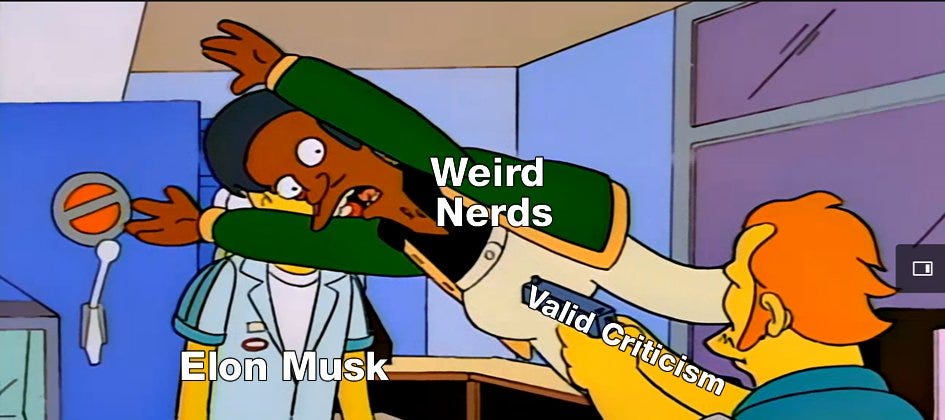
Every new thing I learn about Elon Musk paints a more nightmarish image of him. For example, did you know that Musk also co-founded Neuralink, a company trying to develop brain implants, that killed some or all of the macaque monkeys it experimented on? Records showed there was a "pattern of extreme suffering and staff negligence”, anonymous former employees said Neuralink had a “culture of blame and fear” and a high rate of turnover, and — get this — Neuralink is planning to conduct human trials by the end of this year. Cue those alarm bells.
(Sidebar: There’s other stuff too: Musk has also recently been accused of sexual harassment, regularly union-busts, and Tesla uses non-disclosure agreements to hide the many faults of its tech. Again, this is the richest man on Earth, the only planet we inhabit.)
There is a palpable excitement around this sort of tech, especially online; after all, isn’t the Internet giving us exactly what we couldn’t have even imagined? Everywhere you turn, people are gushing about cryptocurrency, NFTs, and Web3.0.
People like Musk, as well as Mark Zuckerberg, Jeff Bezos, Bill Gates — all those people conspiracy theorists think are secretly lizards — have fed us this narrative that progress cannot and should not be impeded. Just think of what you could be delaying! Don’t you want to be able to scroll your hellish social media feed without using a phone? We’ll put you in a little VR universe with all your friends! After all, Zuckerberg’s motto had been “Move fast and break things”. The things that get broken will be worth it, they say, and we like to think we’d be the ones to benefit from the “move fast” — we never want to imagine ourselves as the ones under the boot.
There’s a fundamental mismatch between those who are moving fast and the rest of us. Technology historian Mar Hicks writes in their introduction to Your Computer is On Fire, “‘Move fast and break things’ ran the motto of these self-styled disruptors, because when you are rich enough, and privileged enough, it might seem like all the breaking you’re doing doesn’t have negative consequences.” We (those of us privileged enough to have access to the Internet) bear the brunt of their recklessness — and the language with which we use to describe them is important, because reckless is what it is, not “innovative” or “cutting edge” or “game changing” — becoming guinea pigs in a billionaires’ playground as things like ethics and community fall to the wayside.
Once we realize, often too late, we turn to the same people to fix things. Historian Thomas S. Mullaney writes in Your Computer is On Fire, “No matter the problem, it seems, a chorus of techno-utopian voices is always at the ready to offer up “solutions” that, remarkably enough, typically involve the same strategies (and personnel) as those that helped give rise to the crisis in the first place.”
And do we ever think about what things we’re breaking? What is this progress at the expense of? You can trace back to the imperialist “civilising mission” the way progress tends to be pitted against tradition, a dynamic being replicated with every new “disruptive” technology pushed into the market. I think a lot about the Vox article from January 2020, titled “The night sky is increasingly dystopian”, which details the devastating effects Elon Musk’s SpaceX’s Starlink satellites have had on astronomical study.

My concern about this is twofold. On the one hand, it is a huge scientific loss: the launch of these satellites are now leaving streaks on telescope observations, causing parts of images to become unusable, and likely to get worse as more satellites are launched. On the other hand, this speaks to the most instinctual, spiritual parts of me. Because these are satellites orbiting Earth, they will be viewable even in the most untouched parts of the world. Growing up in a city with rampant light pollution meant you would be lucky to see any stars at all — so when my family took a trip to Hawai’i years ago, being able to look up and truly see the night sky, identify stars and constellations, and experience just how vast the universe was, was a deeply touching and profound experience. The night sky is an integral part of every culture, not to mention for animals as well — I don’t think it’s conservative of me to say that we should be trying to preserve it. We do not and will never own the night sky, and in breaking the night sky we’re committing to an incredibly tragic act.
Even outside of cultural breakages, recent technologies have actively sabotaged reliable systems already set up in our communities. Video essayist Mia Mulder’s What3Words Is Not A Good App, which mostly discusses the downsides of the What3Words location encoding system started in 2013, uses the example of the way that we order takeout. This is an easy example to wrap our heads around — who doesn’t indulge in some UberEats (or Deliveroo, or Menulog, or Instacart, or [your preferred app here]) occasionally? — and demonstrates the way that tech companies, in their pursuit of a highly profitable tech utopia powered by apps, has forcibly wedged themselves into the process as a middleman. “Two zombie ideas exist around Silicon Valley: that one, old methods are inefficient; and two, new technology is always better.”
Mulder later proposes, “There are two [types of] things in our society: there are things that don’t work, but they’re around, or people used to make money from them; and there are things that do work [that don’t make a lot of money]. And the only way to make money here is either by supporting systems that don’t work because they keep making money, or by sabotaging systems that do work.”
There are many, many more examples of ol’ reliables being broken in the name of progress. Younger generations may not even be aware of these systems, because they are so accustomed to an app-economy where everything convenient is meant to be found online. Recently, social media users have taken to purchasing books from Amazon and then returning them after reading, as a way of getting “free” books (while apparently unaware that libraries exist and offer free books for readers). Writers are horrified, as this method will actively cost authors of the books. Supporting existing systems like libraries — and spreading the word on them — may be more radical than we think. As Hicks writes, “Supporting older, more stable technologies that enhance our society, like the postal system, traditional news media, and citizen-funded public health is as important as rejecting newer technologies that threaten to disrupt and divide.”
Rather than moving fast and breaking things, I’d like to move slower, more consciously. There’s art in stepping carefully into a world we want to build, and being more considerate in which technologies we decide to adopt. Of course, often we are pushed until we feel there is no choice, so there is both an individual and systemic factor in this. But we need to stop hanging our hopes on some delayed promise in the future and believing that “savants” like Musk or Gates will be saving our asses, and let go of the idea that technology is the end or the means, but rather a very small part that only aesthetically seems significant.